News
Wrigley signs on to the FDI Vision 2020 partnership
9 September 2016
Wrigley has become the latest partner to join Vision 2020, an FDI initiative to raise the political profile of oral health among public health officials and other decision-makers at national and international level.
“Wrigley has been a long-time keen supporter of FDI work and I’m delighted they have agreed to sign on to our ambitions in oral health advocacy by strengthening the activities and goals of Vision 2020,” said FDI President Dr Patrick Hescot. “This support will enable us to position oral health where it needs to be: high on the global health agenda.”
“Wrigley is very supportive of the Vision 2020 ambition, to drive awareness among governments and health authorities of the human and economic cost of oral disease, and to develop strategies to address this burden,” said Matthew Kent, Senior Corporate Affairs Manager, Global Oral Care. “Through Vision 2020 we have an opportunity to change behaviours at a grass-roots level, to focus more on prevention oriented oral health care.”
Launched in 2012, Vision 2020 provided a map of the challenges facing the oral health community, which were to:
- Meet the increasing need and demand for oral health care
- Expand the role of the health-care professional
- Shape a responsive educational model
- Mitigate the impacts of socio-economic dynamics
- Foster fundamental and translational research and technology
Today, FDI global advocacy and Vision 2020 have merged into common strategy with a twin focus: on the one hand, ensuring the oral health community is aligned and equipped to put pressure on national governments to address oral disease within national health action plans; on the other ensuring that FDI member national dental associations and the wider oral health community are represented in the international health policy debate.
Wrigley Oral Healthcare Program
The Wrigley Oral Healthcare Program (WOHP) partners with dental professionals worldwide, helping them improve their patients’ oral health through one additional simple and enjoyable step in their daily routine: chewing sugarfree gum after eating and drinking on-the-go. For more than 25 years, WOHP has supported independent clinical research into the benefits of chewing gum, including saliva stimulation, plaque acid neutralization and tooth strengthening to help dental professionals and their patients understand the role of sugarfree gum as a convenient tool for everyday oral care. WOHP is one example of how we make a difference to people and the planet through performance, and how we incorporate our principles based approach to business into all that we do.
Review of latest evidence confirms oral health benefits of sugar-free gum
6 June 2016
By: Michael Dodds, BDS, PhD
A new review of the most up-to-date scientific research reinforces the positive effects of sugar-free gum (SFG) on oral health and emphasizes the identification of active ingredients in gum that could facilitate prevention and removal of oral biofilm.
The review confirmed the oral health benefits of chewing sugar-free gum, including the clearance of food debris, reduction in oral dryness, increase of biofilm pH, remineralization of enamel, freshening breath through the reduction of volatile sulfur compounds and inhibition of extrinsic tooth stain. These benefits are attributed to increased mastication and salivation. The authors say that with the addition of active ingredients in chewing gums, it may be possible to expand these benefits to also include:
- Enhanced inhibition of extrinsic tooth stain and calculus formation.
- Enhanced enamel remineralization.
- Reduction of the numbers of bacteria in saliva and amount of oral biofilm.
- Neutralization of biofilm pH.
- Enhanced reduction of halitosis.
The analysis, which was published in Expert Opinion on Drug Delivery in May 2016, looked at the evidence for oral health benefits of chewing SFG, citing 138 articles, and drawing findings from 69 papers. Its emphasis was on identifying active ingredients in gum that facilitate the prevention and removal of oral biofilm. The evidence shows that while chewing gum can allow active ingredients to be gradually released into the oral cavity, they have a low potency and are rapidly washed out from the oral cavity by increased salivation. Furthermore, the health benefits from increased salivation and mastication may easily overshadow the additional benefits of added active ingredients unless used for prolonged periods of time, making it hard to demonstrate their clinical benefits.
Oral diseases develop when the balance within the oral microbiome is lost and pathogenic bacteria start to dominate. This occurs, for instance, when cariogenic strains in a biofilm produce an excess of acids through fermentation of environmental sugars causing enamel demineralization or when peridontopathogens residing mostly in gingival pockets cause gingivitis or, in more advanced state, periodontitis.
The review confirms the well-documented benefits of chewing SFG associated with increased mastication and salivation, many of which are supported by the European Food Safety Authority (EFSA).
Chewing SFG results in a 10-fold increase in salivary flow rate, which enhances the ability of saliva to clear the mouth of food debris and sugars, neutralize acids and support remineralization, all of which can help to reduce the incidence of dental caries.
While data points to specific benefits for certain active ingredients, such as xylitol, carbamide and polyphosphates, the authors state longer term clinical trials are needed to confirm these benefits. Future studies on active ingredients should focus specifically on targeting pathogenic bacteria, whilst leaving the healthy microbiome unaffected. However, the authors of the review conclude that the basic benefits of the long-term chewing of SFG due to increased mastication and salivation are beyond dispute.
About the author
Michael Dodds, BDS, PhD is Oral Health Lead Scientist at the Wrigley Company, based in Chicago, with responsibility for developing scientific support for the oral health benefits of chewing sugar-free gum. He holds a dental degree from the University of Edinburgh and a PhD in Dental Science from the University of Liverpool. Prior to joining Wrigley in 2002, Dr. Dodds was Associate Professor of Community Dentistry, San Antonio, Texas, and is currently also adjunct Associate Professor of Pediatric Dentistry at the UIC College of Dentistry, Chicago.
Smile Back materials to aid dentist/patient discussions on good oral care routines
1 January 2016
What’s behind a smile? WOHP celebrates the science of smiling on World Oral Health Day
20 March 2015
Today, the Wrigley Oral Healthcare Program (WOHP) joins FDI World Dental Federation, its partners, dental professionals, and patients around the world to celebrate World Oral Health Day (WOHD) and the 2015 theme “Smile for Life.”
Most of us are unaware of just how many physical and neurological components are involved in the simple act of smiling. World Oral Health Day is an important occasion to focus on the science of smiling, and remind patients of the simple oral hygiene routines that can help protect their teeth and smiles, including chewing sugar-free gum.
Smiling requires a number of muscular and neurological features which operate “behind the scenes.” As many as 12 muscles are involved in the creation of a smile, depending on the type of smile and our individual facial characteristics.1 In an unconscious, “genuine” smile, also known as the Duchenne smile in honor of a 19th century French neurologist who studied the mechanism of human facial expression, signals travel from the unconscious areas of the brain to contract facial muscles, in particular the obicularis occuli around the eye and the zygomaticus major which controls the corners of the mouth. Conversely, in a conscious “social” smile, signals from the brain bypass the eyes and contract only the muscles around the mouth.2 Researchers have shown that the Duchenne smile produces greater activity in the brain’s left anterior temporal region and is linked to positive emotions.3
More importantly, a smile is produced—and defined—by its most visible, obvious components: the teeth and gums. The condition, shape, position, and color of the teeth and gums can impact the function and aesthetic appearance of a smile 4 and could potentially influence a person’s desire to smile in public.
“The 2015 World Oral Health Day theme of Smile for Life has two meanings – a lifelong smile and celebrating life,” said FDI President Dr Tin Chun Wong. “The three main dental reasons that people don’t smile are gum disease, tooth decay or tooth loss, so the better we prevent these the more chance we have of keeping our smiles for life.”
Given the important link between teeth and smiles, WOHP supports the goals of World Oral Health Day all year round. WOHP partners with dental professionals to help them improve their patients’ oral health through one extra simple and enjoyable step in their daily routine: chewing sugar-free gum after eating and drinking, particularly while on-the-go. Science demonstrates that chewing sugar-free gum stimulates the production of saliva, increasing the flow rate by up to 10 to 12 times the resting rate, which helps to wash away food debris, neutralize plaque acids and naturally remineralize tooth enamel to help strengthen teeth.
“The Wrigley Oral Healthcare Program is proud to support World Oral Health Day 2015 and to raise awareness of the many factors that enable the simple act of smiling,” said Matthew Kent, Global Wrigley Oral Healthcare Program Manager. “Our teeth play an essential role in our desire and ability to smile. So we are working with dentists, hygienists, and patients to encourage the adoption of oral hygiene behaviors, such as chewing sugar-free gum, that can help keep teeth healthy.”
To learn more about World Oral Health Day, please click here. To learn more about the Wrigley Oral Healthcare Program and the oral health benefits of chewing sugar-free gum, please click here.
About the Wrigley Oral Healthcare Program
WOHP partners with dental professionals worldwide, helping them improve their patients’ oral health through one extra simple and enjoyable step in their daily routine: chewing sugar-free gum after eating and drinking on-the-go. WOHP supports independent clinical research into the benefits of chewing gum, including saliva stimulation, plaque acid neutralization and tooth strengthening. For more information, visit: www.wrigleyoralcare.com
About FDI
FDI World Dental Federation serves as the principal representative body for more than one million dentists worldwide, developing health policy and continuing education programs, speaking as a unified voice for dentistry in international advocacy, and supporting member associations in global oral health promotion activities. Over the years, it has developed programs, initiatives, campaigns, policies and congresses, always with a view to occupying a space that no other not-for-profit group can claim. FDI works at national and international level through its own activities and those of its member dental associations. It is in official relations with the World Health Organization (WHO) and a member of the World Health Professionals Alliance (WHPA). For more information, visit: www.fdiworldental.org
About WOHD
World Oral Health Day (WOHD) is celebrated every year on the 20th March. It is an international day to celebrate the benefits of a healthy mouth and to promote worldwide awareness of the issues around oral health and the importance of looking after oral hygiene to everyone old and young. It is a day for people to have fun – a day that should be full of activities that make us laugh, sing and smile! For more information, visit: www.worldoralhealthday.com
References
- Goldfinger, Eliot. Human Anatomy for Artists: The Elements of Form. Oxford: Oxford University Press, 1997. Pages 69-101.
- Carter, Rita. The Brain Book, 2nd edition. London: DK Publishing, 2014.
- Ekman P, Davidson RJ, Friesen WV. The Duchenne smile: emotional expression and brain physiology. II. J Pers Soc Psychol. 1990;58:342-53.
- Kershaw S, Newton JT. Williams DM. The influence of tooth colour on the perceptions of personal characteristics among female dental patients: comparisons of unmodified, decayed and ‘whitened’ teeth. Br Dent J. 2008; 204:E9.
Wrigley Oral Healthcare Program announces winners of the annual IADR-Wrigley Salivary Research Award
16 March 2015
Six fold increase in entries received for the 2015 award
The Wrigley Oral Healthcare Program is delighted to announce the three winners of the International Association for Dental Research (IADR)-Wrigley Salivary Research Award. Now in its sixth year, the annual award celebrates dental scientists, dental students and non-dental students, from around the world, who have made a significant contribution to salivary research. This year, more than 90 entries (in the form of abstracts) were submitted to the award, which covers three categories:
- Basic Salivary Research Award for a Dental or Non-Dental Student
- Clinical Salivary Research Award for Dental Students
- Clinical Salivary Research Award for Dental Scientists
2015 Winners
- Yuliya Mulyar, The University of Western Ontario, Canada, Wrigley Basic Salivary Research Award for a Dental or Non-Dental Student ($2,000)
- Abstract: Anti-Cariogenic Effect of a Novel Encapsulation System for Salivary Proteins
- Brady Petersen, The University of Nevada, Las Vegas, Wrigley Clinical Salivary Research Award for Dental Students ($1,500)
- Abstract: Exosome Analysis: Oral Squamous Cell Carcinoma MicroRNA Isolation in Culture
- Eduardo Moffa, The University of Western Ontario, Canada, Wrigley Clinical Salivary Research Award for Dental Scientists ($1,500)
- Abstract: Identification of Histatin 5 Salivary Complexes Using Mass Spectrometry
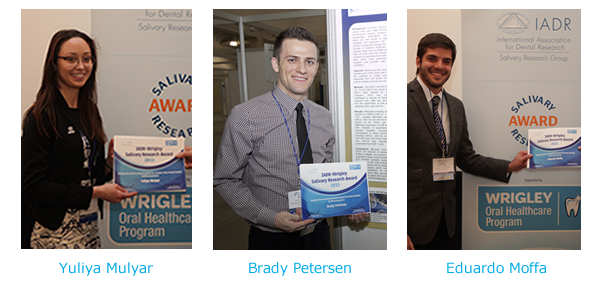
“This is the sixth year that the Wrigley Oral Healthcare Program has supported the award and we are excited to see such a marked increase in interest to carry out research in this fascinating and important field,” said Michael Dodds, BDS, PhD, Oral Health Lead Scientist, Wrigley.
“The work of the three awardees truly demonstrates the diversity of contemporary salivary research, ranging from fundamental understanding of how salivary proteins interact, a system that in the future could be applied to early identification of oral cancers, through to a nano-encapsulation system that uses fragments of salivary proteins to protect enamel from decay”, continues Dr. Dodds. “The new insights from these studies will allow us, and others in the dental field, to continue to build on our knowledge and understanding of the role and benefits of saliva in maintaining oral health.”
The IADR General Session, taking place in Boston from March 11-14, is a worldwide networking opportunity for the craniofacial, oral and dental research community. More than 5,000 delegates are in attendance, including representatives from 60 leading dental companies and institutions, and more than 3,000 scientific abstracts will be presented.
The partnership between the Wrigley Oral Healthcare Program and the IADR Salivary Research Group was inaugurated, along with the award, in 2010 and continues to expand its global reach. The Wrigley Oral Healthcare Program contribution, in the form of a travel bursary, enabled the winners to attend the General Session and present their research findings.
To learn more about the Wrigley Oral Healthcare Program, please click here